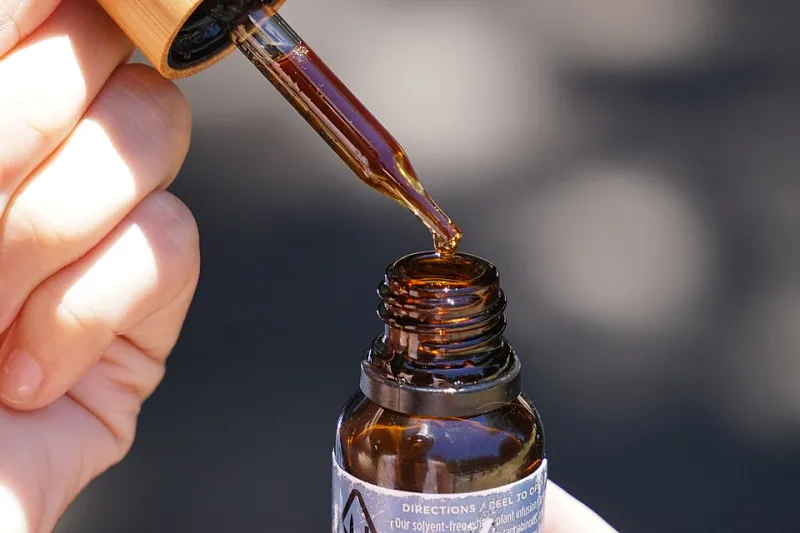
The Two-Handed Bottle: Opening 20 UK CBD Oils When Your Grip Has Opinions

Photo: Chairman of the Joint Chiefs of Staff from Washington D.C, United States, Public domain, via Wikimedia Commons
A CBD bottle has a job before you ever taste the oil: it has to stay shut for a child and still open for the adult who bought it. That second part gets far less attention. So we gathered 20 UK CBD oils and sprays, handed them to a mixed group of adults, and asked a simple question — how long does the cap take, and who gets left behind?
This was not a laboratory safety test. We are not certifying child resistance. We were looking at the everyday friction of a product many people use daily, often with hands that are tired, sore, arthritic, or simply holding a cup of tea at the same time.
How we ran the opening test
We bought 20 products from UK retailers — a mix of online shops and high street stock — across oil strengths, bottle sizes and price points. The group included office workers, a retired couple, one participant with diagnosed arthritis in both thumbs, one with hypermobility, a left-handed tester and someone with long nails. Everyone opened each bottle once cold, then again after a short break.
We timed the first successful open, noted the closure type and stopped at 90 seconds if the cap would not budge. We also read the packaging instructions, checked product pages and contacted brands where the cap gave us trouble. The products split roughly into seven press-and-turn caps, five squeeze-and-turn caps, four plain screw caps, two separate dropper assemblies and two spray tops.
The clock was more useful than the label
Plain screw caps were fastest, as you would expect. Press-and-turn caps had a median first-open time of about 12 seconds, dropping to around five seconds on the second attempt once the tester had found the sweet spot. Squeeze-and-turn caps were slower — roughly 18 seconds at first — and produced most of the audible grumbles.
Two bottles went past the 90-second mark for at least two participants. Both had smooth, narrow caps and stiff springs. The participant with arthritis needed a non-slip mat and, in one case, a tea towel to get enough purchase. The left-handed tester found several caps with arrows that assumed a right-hand twist. Long nails made press-down caps awkward but not impossible; squeeze caps were worse.
By the second attempt, most people had learned the trick. That matters. A cap that is hard once is annoying; a cap that is hard every morning is a daily barrier.
Where the instructions lost the plot
Several bottles relied on a tiny pictogram with no words. One had arrows so small they disappeared under a thumb. Another said “push down and turn” when the cap actually needed a squeeze and a turn. A third had a QR code that led to a general brand homepage, not opening guidance.
We found no UK CBD brand in our sample offering an alternative closure for people with weaker grip, and only a handful mentioned accessibility anywhere on their site. One product page had a helpful close-up photo of the cap. Most did not. If you are buying online, that photo is often the only clue you get before the bottle lands.
Child-resistant does not always mean adult-friendly
The best closures had wide caps with deep ridges, clear arrows and a movement that could be done with the bottle resting on a table. The worst were slim, glossy and sprung so tightly that the cap demanded a firm pinch — exactly the motion that hurts when your hands are already sore.
Spray tops were a mixed bag. Some were easier than oils because they did not need a dropper, but two spray caps needed a strong thumb press. Separate dropper caps were simple to remove, though the glass pipette brought its own grip issues. Tamper-evident shrink wrap over the cap added another step and, on one bottle, made the cap harder to grip until the wrap was fully removed.
What the brands said
We contacted every brand whose cap caused a problem. Six replied. Two sent useful tips — rest the bottle on a non-slip surface, use the flat of your hand rather than fingertips, check that the arrows are aligned before pressing. None offered a different cap. One suggested decanting the oil into a smaller bottle, which we would not recommend for anyone who relies on the original label and dose markings.
A few brands said the closure was chosen for child safety and that they had no plans to change it. That is fair. Child-resistant packaging exists for a reason. But safety and accessibility are not opposites; they are both design jobs.
The practical takeaway
If you have arthritis, carpal tunnel, long nails or simply a weak grip, treat the cap as part of the product. Before you buy a large bottle or a multi-pack, check the product photos, look for close-ups of the closure, and ask the brand directly what type of cap it uses. A narrow press-and-turn cap is not the same experience as a wide ridged one, even if both are called child-resistant.
Do not assume a spray will be easier, and do not assume a high-strength oil will be harder — the cap often depends on the bottle, not the millilitres. Keep a non-slip mat by the kettle. Open over a table, not over the sink. And if a cap is genuinely faulty, ask the retailer about a return rather than fighting it every morning.
The ideal CBD bottle keeps a child out and lets an adult in without a wrestle. Across 20 UK products, that balance was uneven. The best caps disappeared into the routine. The worst became the first thing you noticed about the oil — and that is not the part anyone came for.